

Power Your Software Testing with AI Agents and Cloud
The Native AI-Agentic Cloud Platform to Supercharge Quality Engineering. Test Intelligently and Ship Faster.


- TestMu AI (Formerly LambdaTest)
- /
- Learning Hub
- /
- V-Model in Software Development: Phases, Benefits & Tools
V-Model in Software Development: Phases, Benefits & Tools
Understand the V-Model in software development, phases, pros, use cases, tools, and how it compares with the Waterfall model. All explained with examples.
Last Updated on:
On This Page
- What is the V-Model?
- Phases of the V-Model
- Verification vs Validation in the V-Model
- Why is V-Model Design Important?
- Principles of the V-Model
- V-Model vs Waterfall Model: What’s the Difference?
- When to Use the V-Model?
- Compliance Standards and the V-Model in Systems Engineering
- Pros and Cons of the V-Model
- Tools and Technologies Used in the V-Model
- Best Platforms for the V-Model Systems Engineering Lifecycle
- How the V-Model Pioneered Shift-Left QA
- Modern Relevance of the V-Model
- The Future of the V-Model in Software Development
The V-Model is a structured software development approach where every development phase is paired with a corresponding testing phase. It’s designed to catch bugs early, improve quality, and ensure clear documentation throughout the process. In this detailed guide, we’ll cover what the V-Model is, how it works, when to use it, and why it’s still relevant today.
Key Takeaways
- The V-Model is a linear development methodology in which every development phase is paired with a matching testing phase, with design work on the left arm and its verification on the right.
- V-Model phases pair requirement analysis with acceptance testing, system design with system testing, architectural design with integration testing, module design with unit testing, and coding with code reviews.
- Verification asks whether the product is being built right against the specification, while validation asks whether the right product is being built for the user's actual need.
- Writing the acceptance test during the requirements phase is the V-Model's most useful habit, because a requirement nobody can write a test for is a requirement nobody understands yet.
- The V-Model costs show up as rigidity when requirements change, heavy documentation work, and slower time to market, so it suits stable scopes rather than fast-moving products.
- The V-Model fits small to mid-size projects with fixed requirements and safety-critical systems in aerospace, automotive, and healthcare, where documentation and traceability are mandatory.
- ISO 26262 is explicitly built on a V-model reference process, while DO-178C and IEC 62304 stay lifecycle-agnostic and ask instead for bidirectional traceability and verification proportionate to risk.
- TestMu AI runs manual and automated tests across 3,000+ browser and OS combinations and 10,000+ real devices, and its logs, screenshots, and video recordings support V-Model traceability records.
What is the V-Model?
The V-Model is a linear software development methodology that organizes the process into distinct stages, with testing activities running parallel to each development phase. This model emphasizes the importance of verification vs validation throughout the lifecycle of a project. The "V" shape represents the process: the left side shows the stages of development, while the right side mirrors the corresponding testing activities.
Each phase in the development process corresponds with a testing phase, creating a balanced approach where validation and verification are prioritized early and consistently throughout the process.
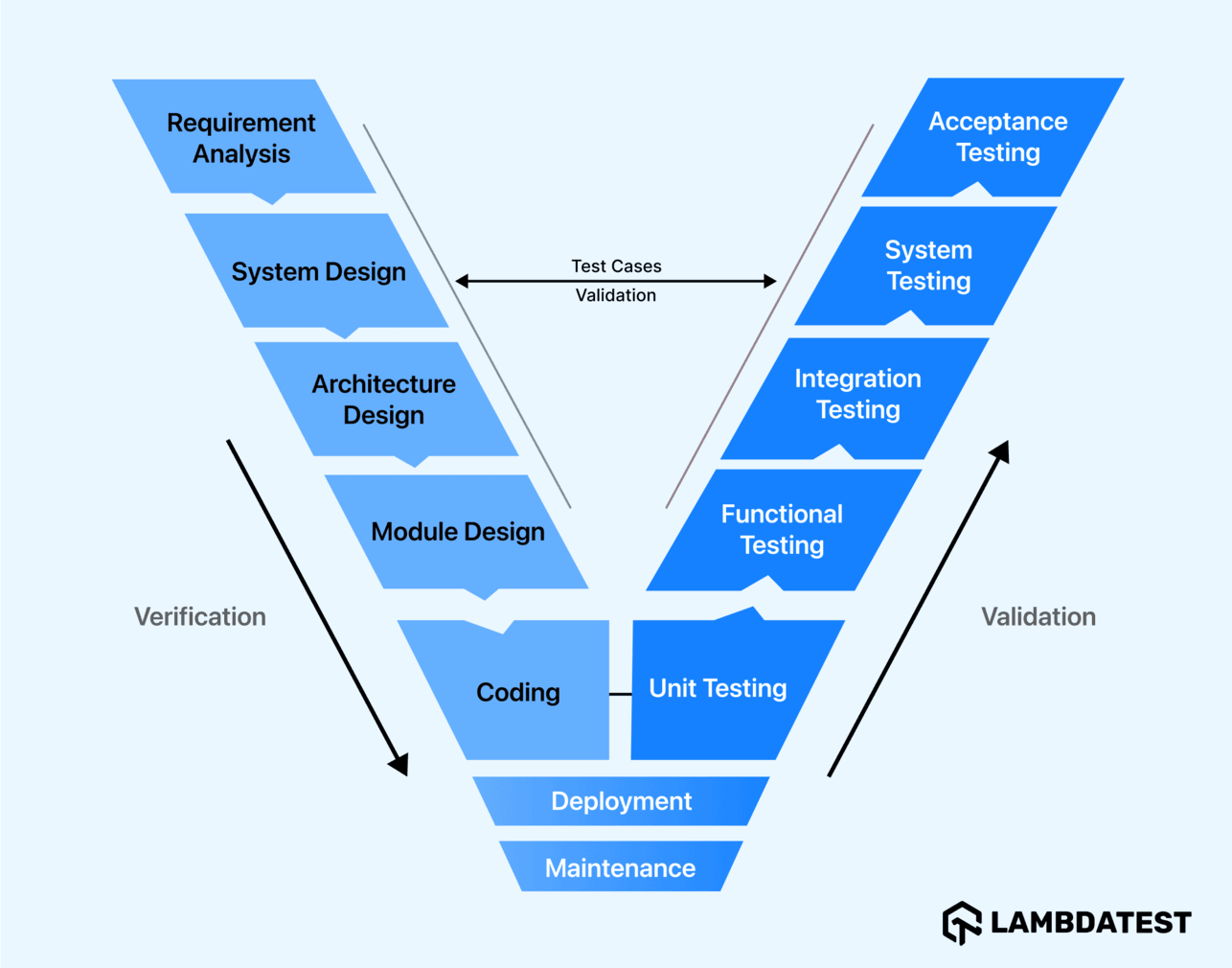
Phases of the V-Model
| Phase | Development Phase | Testing Phase | What It Checks |
|---|---|---|---|
| Requirement Analysis | Gather and define user needs. | Acceptance Testing | Does the system meet user expectations? |
| System Design | Plan system architecture and components. | System Testing | Does the full system work as a whole? |
| Architectural Design | Define tech stack and module interactions. | Integration Testing | Do modules communicate and function together properly? |
| Module Design | Break down into modules; define logic. | Unit Testing | Do individual modules work as expected? |
| Coding | Write the actual code. | Code Reviews / Unit | Are there any coding errors or logic issues? |
| Deployment | Push software to the live/staging environment. | Deployment Testing | Is the setup right for production use? |
| Maintenance | Fix bugs and roll out updates. | Regression Testing | Did new changes break anything? |
Verification vs Validation in the V-Model
The V in V-Model stands for Verification and Validation, and the two words are not synonyms. The distinction is the whole reason the model has two sides, and it collapses into one question each:
- Verification asks: are we building the product right? Does what we built match the specification we agreed to?
- Validation asks: are we building the right product? Does the thing we built actually solve the user's problem, whatever the specification said?
Software can pass verification completely and fail validation completely. Build precisely what the specification described, and if the specification described the wrong system, every test goes green and the product is still useless. That failure mode is exactly what the V-Model's right side is arranged to catch, which is why acceptance testing is paired with requirements rather than bolted on at the end.
| Aspect | Verification | Validation |
|---|---|---|
| The question it answers | Are we building the product right? | Are we building the right product? |
| Compares against | The specification and design documents. | The user's actual need and intended use. |
| Typical activities | Reviews, walkthroughs, inspections, static analysis, unit and integration testing. | System testing, acceptance testing, usability testing, beta and field trials. |
| Needs running code? | Not always. Much of it happens on documents and models before code exists. | Yes. Validation needs something a user can exercise. |
| When it happens in the V | Down the left side and at the lower right, close to the code. | At the upper right, against the requirements it was paired with. |
| A failure means | The implementation drifted from the spec. | The spec itself was wrong, even if the build was faithful. |
| Who usually signs off | Engineering and QA. | The customer, product owner, or regulator. |
A useful shorthand: verification is an internal check against a document, validation is an external check against reality. For a deeper treatment, refer to this blog on verification vs validation.
Why is V-Model Design Important?
In traditional models, testing often comes after development, making bug fixes time-consuming and costly. But the V-Model flips the script by pairing every development stage with a corresponding testing phase, starting from day one. This means potential issues are spotted early, not after the product is built.
Here’s why the V-Model matters:1. Early Bug Detection = Cost Saving
Detecting defects during the requirement or design phases is 10x cheaper than fixing them post-deployment. V-Model’s parallel testing approach prevents late-stage surprises.
2. Clear Structure & Discipline
The V-Model follows a step-by-step and highly organized approach, making it ideal for regulated industries (like healthcare or finance) that require strict documentation and traceability.
3. Testing is Built-In, Not Bolted-On
With testing planned alongside development, QA teams prepare test cases early, reducing the feedback loop and enabling faster improvements.
4. Better Project Transparency
Each phase has clearly defined deliverables, so stakeholders can track progress easily and make timely decisions.
5. Strong Risk Management
By validating each stage before moving forward, the V-Model reduces technical debt and minimizes project risks like scope creep, mismatched requirements, or missed deadlines.
6. Encourages Developer-Tester Collaboration
The model naturally promotes teamwork, developers and testers work in sync, leading to shared accountability and improved software quality.
7. Ideal for Stable & Well-Defined Projects
If requirements are clear from the start, the V-Model is extremely efficient, it avoids scope shifts and focuses on delivering what’s promised with precision.
Principles of the V-Model
The V-Model is centered on a few core principles that make it distinctive in the world of software development methodologies:
- Early Involvement of Testing: Testing activities are planned in parallel with the development phases. Each stage of development has a corresponding testing phase that begins immediately after the development phase is completed.
- Verification and Validation: The model emphasizes verifying the design and validating the end product to ensure they meet user requirements. Verification ensures the product is being built right, while validation ensures the right product is being built.
- Sequential and Structured Approach: The V-Model follows a step-by-step process where each phase of development flows into the corresponding testing phase. This structured approach ensures that no step is skipped, reducing the risk of errors and missed requirements.
- Clear Documentation: The V-Model requires comprehensive documentation at each stage, making the process transparent and easy to trace. This documentation is crucial for accountability and review in regulated industries.
- Focus on Quality Assurance: Continuous testing and verification ensure that defects are caught early, and the product is of high quality at every stage, which focuses on quality assurance.
V-Model vs Waterfall Model: What’s the Difference?
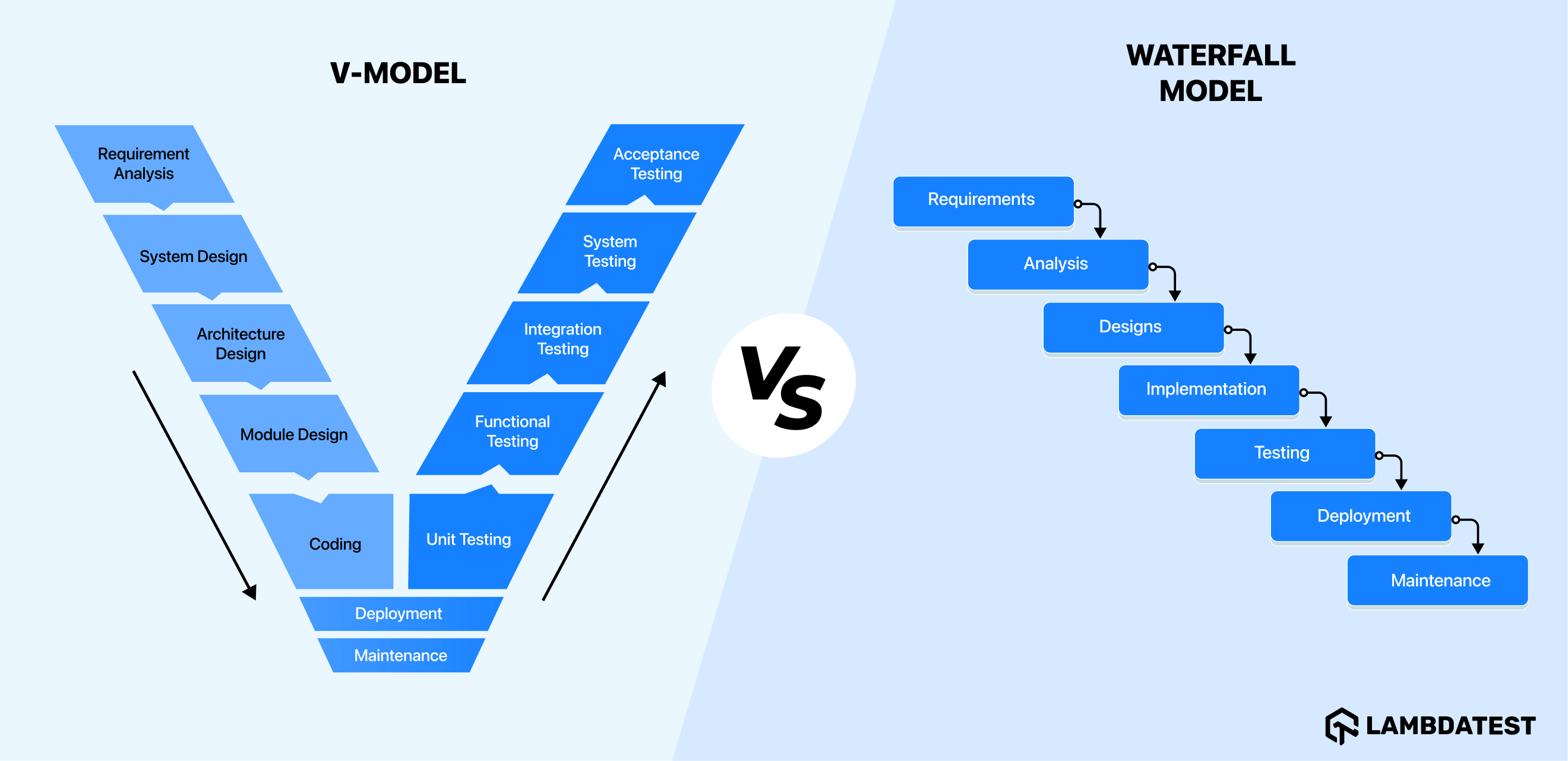
While both the V-Model and Waterfall Model follow a structured approach, they differ in how they handle testing, risk, and project flexibility. Here's a detailed comparison:
| Feature | V-Model | Waterfall Model |
|---|---|---|
| Development Approach | Linear, but testing is planned in parallel with development. | Strictly sequential, with one phase completing before the next begins. |
| Testing Integration | Testing phases are mapped to each development phase (e.g., unit, integration). | Testing happens only after development is fully completed. |
| Bug Detection Timing | Bugs are caught early, reducing the cost of fixing them. | Bugs are detected late, often during final testing, increasing rework. |
| Project Flexibility | Suitable for projects with clear and stable requirements. | Best for small projects with minimal scope changes. |
| Validation & Verification | Strong emphasis on both verification and validation throughout. | Validation occurs at the end, risking missed alignment with user needs. |
| Documentation Needs | Requires detailed documentation at every stage for traceability and compliance. | Documentation is typically produced after each completed phase. |
| Risk Management | Better risk control due to continuous testing and validation. | Higher chance of risks due to late feedback and testing. |
| Use Case Suitability | Ideal for regulated industries (e.g., medical devices, automotive, aerospace). | Often used in academic projects or traditional IT systems with fixed scope. |
| Maintenance Phase | Includes planned regression testing after updates or bug fixes. | Maintenance is done as needed, but not well integrated with initial testing. |
| Example | Developing a medical monitoring system where accuracy and safety are critical. | Creating a college library website with basic features and fixed functionality. |
When to Use the V-Model?
The V-Model is best suited for projects where requirements are well-defined, stable, and unlikely to change during the development process. It works exceptionally well for systems that require high reliability, safety, and documentation, such as in industries like aerospace, automotive, and healthcare. In these sectors, the V-Model’s emphasis on verification and validation ensures that every development stage is rigorously tested and meets strict standards.
Use the V-Model in the following scenarios:
- Clear and Fixed Requirements: Projects with well-understood requirements that are unlikely to change over time.
- Regulatory Compliance: Systems where documentation and traceability are critical to meet regulatory standards.
- Safety-Critical Systems: Projects where failure could lead to significant consequences (e.g., healthcare devices, automotive software).
- Smaller to Medium-Sized Projects: The V-Model’s structured approach makes it ideal for projects that can be completed in a linear fashion.
However, it may not be suitable for projects that need iterative development or constant changes in scope, such as those in fast-paced tech industries.
Compliance Standards and the V-Model in Systems Engineering
Outside consumer software, the V-Model is not a stylistic preference. In automotive, aerospace, medical devices, and rail, you cannot ship without demonstrating to an assessor that every requirement was implemented and independently verified, and that you can prove the link between the two. The V-Model is the shape that argument takes.
It is worth being precise about what these standards actually demand, because a lot of writing on this topic overstates it. Most of them do not name the V-Model and mandate it. What they mandate is bidirectional traceability, verification proportionate to risk, and independence between the people who build and the people who assess. ISO 26262 is the clearest case in the other direction: the series is explicitly built on a V-model as its reference process model, and EN 50716 keeps a linear V-shaped lifecycle. DO-178C and IEC 62304 are deliberately lifecycle-agnostic: they define objectives and processes and require you to define a lifecycle, then satisfy the objectives within it. DO-178C is a process-oriented assurance framework rather than a prescriptive process model, and its own flexibility about lifecycle style is a design decision, not an oversight. The V-Model dominates there not because the text compels it, but because it is the cheapest structure that produces the evidence these standards ask for.
| Standard | Domain | Risk Classification | Relationship to the V-Model |
|---|---|---|---|
| ISO 26262 | Road vehicles, functional safety | QM, then ASIL A to ASIL D, with D the most stringent | The series is explicitly built on a V-model as its reference process model. Part 6 covers product development at the software level. |
| DO-178C | Airborne systems and equipment | Design Assurance Level A to E, with A covering catastrophic failure conditions | Objective-based and lifecycle-agnostic. It does not mandate the V, but its traceability and independence objectives make the V the standard way to satisfy it. |
| IEC 62304 | Medical device software lifecycle processes | Software safety classes A, B, C, escalating with potential for injury | Defines required processes rather than a lifecycle model. You must declare a lifecycle; most manufacturers declare a V. |
| EN 50716 (replacing EN 50128) | Railway software, unifying control and signalling with on-board rolling stock | Basic Integrity, then SW-SIL 1 to SW-SIL 4, with 4 the highest | Retains a linear V-shaped lifecycle running from specification through to validation, with Annex C newly permitting planned iterations. |
If you work in rail, note the date. EN 50716:2023 was published in the last quarter of 2023 and replaced both EN 50128:2011 and EN 50657:2017, which were withdrawn in November 2023. The three coexist only until the end of October 2026, after which EN 50716 is the sole accepted reference. Two changes matter beyond the renumbering: SIL 0 is replaced by Basic Integrity, and Annex C now allows you to plan iterations, incrementally building products rather than treating a second pass through a phase as error correction. That is a notable concession. The most V-committed standard in the set has just written iteration into the model on purpose.
Two consequences follow, and both explain why safety-critical teams tolerate the V-Model's rigidity.
Rigor scales with risk. None of these standards ask for the same effort everywhere. A component rated ASIL D or DAL A attracts requirements that a QM-rated or DAL E component does not, including structural coverage obligations and independence between developer and verifier. The classification is decided during hazard analysis at the top of the left arm of the V, which means the V's very first phase determines how expensive its right arm will be. Teams that skip that analysis discover the cost late, which is the worst time.
The traceability matrix is the deliverable. In a regulated build the requirements traceability matrix is not project admin, it is the artifact the assessor reads. It has to run in both directions: forward from each requirement to the design, code, and tests that satisfy it, and backward from each piece of code to the requirement that justifies its existence. The backward direction is the one people underestimate. Code with no requirement behind it is not a bonus feature, it is unjustified behavior in a safety system, and it has to be removed or a requirement has to be written for it. The V-Model produces this matrix as a by-product of its structure, which is precisely why it survives in these industries.
There is also a formal V-Model lineage worth knowing. Germany's V-Modell was first published by the German armed forces in 1992, revised as V-Modell 97, and replaced in February 2005 by V-Modell XT, where XT stands for eXtreme Tailoring. That name is the point: the model is deliberately larger than any one project needs, and tailoring it down to fit the project is a required first step rather than a shortcut. It remains a development standard for German federal administration and defence projects. For related process context, refer to this guide on compliance monitoring.
Key Takeaway: Most of these standards do not name the V-Model. ISO 26262 is built on a V-model reference process and EN 50716 keeps a linear V-shaped lifecycle, while DO-178C and IEC 62304 define objectives and let each team declare its own lifecycle. What all of them demand is bidirectional traceability, verification proportionate to risk, and independence between the people who build and the people who assess, and the V-Model produces that evidence as a by-product of its structure.
Pros and Cons of the V-Model
The V-Model offers a structured development process with early testing benefits, but its rigid nature can limit flexibility. Here's a quick look at its pros and cons.
Pros of the V-Model
- Bad requirements get caught before any code exists: This is the model's most underrated benefit. Writing the acceptance test during the requirements phase forces someone to answer "how would I know if this were true?" A requirement nobody can write a test for is a requirement nobody actually understands yet, and the V-Model surfaces that on day one rather than during acceptance testing six months later. Ambiguity is cheapest to fix while it is still a sentence in a document.
- Early defect detection lowers cost: Defects found during requirements or design are dramatically cheaper to fix than the same defects found after deployment, because the fix touches a document rather than code, tests, and a release.
- Traceability comes for free: Because every phase is paired with its verification phase by construction, the links between requirements, design, code, and tests fall out of the process rather than being reconstructed afterward. Teams using less structured models pay for this later, at much higher cost, when an auditor asks for it.
- Clear deliverables and honest progress: Each phase has defined entry and exit criteria, so "we are 60% done" means something checkable rather than optimistic. Stakeholders can see where the project actually is.
- Documentation that satisfies assessors: The paperwork the model demands is the same paperwork a regulator wants to see. In safety-critical domains this turns the V-Model's biggest overhead into its main advantage.
- Testers and developers work in parallel from the start: QA is not waiting downstream for a build. Test design happens alongside design, which spreads quality accountability across the team instead of concentrating it at the end.
Cons of the V-Model
- Rigidity and Lack of Flexibility: The V-Model is a linear and sequential approach, which makes it difficult to accommodate changes once the development process begins. If requirements change during the project, it can be challenging to adapt.
- Resource-Intensive: The need for extensive documentation and parallel testing increases both the time and cost of the project. This can lead to resource constraints, especially for smaller teams.
- Limited Adaptability for Complex Projects: Projects with complex and evolving requirements may find the V-Model limiting, as it does not lend itself well to iterative or incremental development like Agile or DevOps.
- Slow to Market: Since all development steps must be completed before moving on to the next, the V-Model can be slower than more flexible approaches, making it less suitable for fast-moving industries.
- Overemphasis on Documentation: The heavy focus on documentation can lead to delays and could potentially distract from more critical aspects of development, like feature development or user feedback.
While the V-Model is effective, it does face challenges such as the above. To overcome these limitations, teams can leverage platforms that provide cross-environment testing capabilities, enabling high-volume, complex test execution without the burden of setting up or maintaining test infrastructure. One such platform is TestMu AI.
TestMu AI is a GenAI-native intelligent test orchestration and execution platform that helps you run both manual and automated tests at scale across 3000+ real browsers, 10,000+ devices, and operating systems. It empowers QA teams to:
- Parallel testing across multiple environments for faster feedback.
- Automate unit, integration, and regression tests, even during early phases of the V-Model.
- Eliminate infrastructure setup, making testing more agile within the V-Model’s rigid structure.
- Access detailed logs, screenshots, and video recordings to support traceability and documentation requirements.
By integrating TestMu AI into your V-Model workflow, you bring speed, flexibility, and real-time visibility to an otherwise sequential and rigid process, making the model more adaptable for today’s fast-paced development needs.
Key Takeaway: The V-Model pays off through early defect detection, traceability that falls out of the process, clear phase deliverables, and testers who work alongside developers from the start. It costs rigidity once requirements change, extensive documentation, and a slower route to market, which is why it suits regulated and safety-critical work far better than fast-moving consumer products.

Tools and Technologies Used in the V-Model
A flat list of tools is not much use for a model whose whole point is that each phase has a counterpart. The table below maps tooling to where it does its work in the V, so you can see which tools serve the left arm, which serve the right arm, and which span both.
| V-Model Phase | Arm | Tool Category | Examples |
|---|---|---|---|
| Requirement analysis | Left (build) | Requirements management | IBM DOORS / Engineering Lifecycle Management, Jama Connect, Siemens Polarion ALM |
| System and architectural design | Left (build) | Modeling and model-based design | MATLAB/Simulink, SysML tooling, Enterprise Architect |
| Module design and coding | Left (build) | Version control and static analysis | Git, SonarQube, Polyspace, Coverity |
| Unit testing | Right (check) | Unit test frameworks and coverage | JUnit, NUnit, pytest, Simulink Test |
| Integration testing | Right (check) | Integration and API testing | TestNG, REST Assured, Postman, hardware-in-the-loop rigs |
| System and acceptance testing | Right (check) | Test automation and test management | Selenium, TestMu AI, IBM Engineering Test Management, Polarion |
| Every phase | Spans both arms | Traceability and ALM backbone | Polarion, Jama Connect, IBM ELM |
| Every phase | Spans both arms | CI and defect tracking | Jenkins, GitHub Actions, JIRA, Bugzilla |
- Version Control: A system used to manage code and track changes over time (e.g., Git).
- Test automation platform: Tools like Selenium, JUnit, and TestNG are used for automated unit, integration, and system testing.
- Continuous Integration Tools: Tools such as Jenkins and Travis CI help automate testing and integration throughout the development cycle.
- Requirements Management Tools Tools like IBM Rational DOORS help capture and track requirements, ensuring alignment between development and testing phases.
- Bug Tracking Tools: Tools such as JIRA and Bugzilla are used for managing defects identified during testing.
The honest caveat is that the V and shift-left disagree about batch size, and that difference is real. The V pairs phases once across an entire project; shift-left in a CI/CD context pairs them continuously, per story, per commit. Agile teams that adopted shift-left kept the V's insight and discarded its sequencing. That is a genuine improvement rather than a betrayal, and it is why the argument between the two models is less interesting than it looks: they agree on the mechanism and differ on the interval. Refer to this blog on shift-left testing for the modern practice, and this one on the future of QA and SDET roles for where these roles are heading.
Modern Relevance of the V-Model
While the V-Model was widely used in the past, especially for large, mission-critical systems (like those in aerospace, automotive, and healthcare), its principles continue to influence modern software development, particularly in regulated industries that require extensive documentation, traceability, and structured testing. However, it’s important to note that the V-Model has limitations when it comes to projects that require flexibility and adaptability, such as those in fast-paced, dynamic environments.
- Integration with Agile and DevOps: The V-Model has seen adaptations to better fit modern agile and DevOps environments. In some cases, organizations have incorporated Agile testing principles within the V-Model framework, running tests iteratively while maintaining the V-Model's structured approach.
- Safety-Critical Systems: The V-Model remains an industry standard in sectors like aerospace and automotive, where safety-critical systems must undergo rigorous validation and verification at each stage.
The Future of the V-Model in Software Development
As software development evolves, so too does the V-Model. Although newer methodologies like Agile and DevOps have gained popularity, the V-Model remains relevant for projects that demand strict adherence to regulatory standards and where the cost of failure is high. For industries like aerospace, automotive, and healthcare, where quality, safety, and documentation are critical, the V-Model will continue to be an essential framework.
Furthermore, integrating automation into the V-Model can help reduce the model's inherent inefficiencies, allowing for a more agile-like iteration of testing and development within the strict structure of the V-Model.
Author

Asad Khan
Blogs: 6


Asad Khan is the Co-Founder and CEO of TestMu AI (formerly LambdaTest), with over 15 years of experience in software testing, product strategy, and leadership. Under his leadership, TestMu AI has grown into an AI-native software testing platform trusted by 2.5M+ users across 132 countries, including startups, enterprises, and Fortune 500 companies. He is a member of the Forbes Technology Council and is followed by 39,000+ professionals on LinkedIn from the software testing and quality assurance community. Before TestMu AI, Asad co-founded 360logica, a software testing company that he grew into a multi-million-dollar business before its acquisition by Saksoft. Earlier, he began his career at GlobalLogic as a Lead Engineer serving top Wall Street banks. He holds a Bachelor of Technology from JSS Academy of Technical Education, Noida.
Reviewer

Mayank Bhola
Reviewer
Mayank Bhola is Co-Founder and Head of Products at TestMu AI (formerly LambdaTest), where he leads the entire product portfolio across KaneAI, Kane CLI, HyperExecute, SmartUI, the Real Device Cloud, Accessibility, and other software testing product lines. As an early Lead Architect he designed and built the company's flagship Tunnel technology from scratch, created the React-based automation platform, and architected the data-intensive pipelines and FAAS services that scale it. He brings more than 10 years of experience in software development and product engineering, with earlier roles as Head of Technology at Juggernaut Books and Senior Software Engineer at PressPlay TV and Zomato. Mayank holds a B.Tech in Computer Engineering from JIIT Noida.


Frequently asked questions
Did you find this page helpful?
More Related Learning Hubs
TestMu AI forEnterprise
Get access to solutions built on Enterprise
grade security, privacy, & compliance
- Advanced access controls
- Advanced data retention rules
- Advanced Local Testing
- Premium Support options
- Early access to beta features
- Private Slack Channel
- Unlimited Manual Accessibility DevTools Tests