

Power Your Software Testing with AI Agents and Cloud
The Native AI-Agentic Cloud Platform to Supercharge Quality Engineering. Test Intelligently and Ship Faster.


- TestMu AI (Formerly LambdaTest)
- /
- Learning Hub
- /
- What is Risk Based Testing: With Best Practices
What is Risk Based Testing: With Best Practices
Master risk based testing with our tutorial. Understand how to identify high-risk scenarios, prioritize testing efforts, and mitigate potential issues.
Last Updated on:
On This Page
- What is Risk Based Testing?
- Why Perform It?
- Real-World Examples
- Benefits
- Features
- When to Use
- Defining Risk
- Types of Risk
- Who Performs It?
- Techniques
- Phases
- Approaches
- System Testing Approach
- Checklist
- Choosing Tools
- How to Perform
- Metrics
- Reports
- The 4 Pillars
- Requirements-Based Testing
- Session-Based Testing
- Mistakes to Avoid
- Challenges
- Best Practices
Risk based testing (RBT) is a type of software testing that focuses on identifying and prioritizing high-risk areas of the software applications being tested. In simple terms, risk based testing is an approach that evaluates the features of software applications at high risk of failure based on software complexity.
Even though there are other software testing types like white box testing, grey box testing, and system testing that focus on testing every feature of software applications, why do we need risk based testing?
In the software development process, testing is indispensable for assuring the quality of software applications and evolves with time by introducing new software testing techniques and methodologies. Its primary focus is thoroughly testing every component, feature, line of code, and others.
However, an organization may face time and budget constraints that force the development team to make the most of it in the limited resource. In this case, the focus is given more to the features or components of software applications that matter the most. Here comes risk based testing, which allows testers to focus their time and resources on the testing software's most critical areas and improve the product's overall quality.
Overview
To optimize software quality assurance under tight resource constraints, use risk-based testing to prioritize application features by their likelihood and impact of failure. This targeted approach focuses testing efforts where failures would cause the most damage, while requirements-based testing is reserved for proving compliance in highly regulated, safety-critical projects.
How Do You Decide What to Test First?
- Best for prioritizing test cases: Risk scoring - multiplies failure likelihood by impact across the four pillars of identification, analysis, response planning, and continuous monitoring.
How Does It Differ From Requirements-Based and Session-Based Testing?
- Best for uneven risk: Risk-based testing - prioritizes test execution based on the likelihood and impact of failure, making it ideal for short testing windows.
- Best for regulated systems: Requirements-based testing - validates every product requirement using a traceability matrix, making it ideal for safety-critical software.
- Best for poorly specified features: Session-based testing - uses time-boxed exploratory sessions guided by a charter to evaluate new or undocumented functionality.
How Do You Know Which Areas Are Actually Risky?
- Best for identifying risky areas: TestMu AI - uses test intelligence to surface flaky tests and failure trends from real runs, helping teams re-score risk registers with empirical evidence.
What is Risk Based Testing?
Risk-based testing is a testing approach that prioritizes the features and functions to be tested based on the risk of failure. It's a strategy that focuses on the areas of the software that carry the highest risk, helping teams to use their testing resources more efficiently.
Risk based testing is an essential approach to software testing, helps reduce testing efforts and costs, identify critical defects early in the Software Development Life Cycle, and ensures the delivery of high-quality software applications to end users. Using Risk based testing, software professionals can make informed decisions about the testing process, focusing their efforts on areas that pose the highest risk to the software applications.
The factors that pose a high risk to software applications may include complex code, code critical to the function of the software application, etc. However, risk levels are also impacted by the type of features or software applications being developed. In risk based testing, such factors are addressed and help focus on the part of the software application that is more likely to encounter bugs.
Why perform Risk Based Testing?
Risk based testing serves a multifaceted purpose. Primarily, it establishes a framework to develop transparent communication among stakeholders concerning the software project risks. This framework helps define standard communication within the team, making risks visible and more amenable to being fixed.
The need for risk based testing arises because it is not always possible to exhaustively test every aspect of software applications within the available time and budget. By identifying and assessing the risks associated with the software applications under test, a risk based testing approach can help testers focus their testing efforts on the areas of the software applications that are most critical and likely to cause issues.
This can help ensure that the software applications are thoroughly tested within the available time and budget and that the most critical issues are addressed before the software applications are released to users.
Risk based testing can also help identify and mitigate risks early in the development process, which can help reduce the cost and impact of defects discovered later in the development cycle or after the software application is released.

Note: Get instant access to 3000+ desktop and mobile environments.Try TestMu AI Now!
Real-World Examples of Risk Based Testing
Suppose a software testing team works on an eCommerce website that allows customers to purchase products online. Your team has identified the following risks:
- The payment gateway is not secure, leading to the potential for unauthorized access and theft of customer payment information.
- The search functionality does not return accurate results, causing frustration for customers and potential loss of sales.
- The checkout process is not user-friendly, leading to abandoned shopping carts and potential loss of sales.
Based on these risks, your team would prioritize testing efforts accordingly. For example, you may allocate more resources to testing the payment gateway to ensure it is secure and prevent potential breaches. Additionally, you would prioritize testing the search functionality and checkout process to ensure they are user-friendly and accurate to avoid losing customers.
By adopting a risk based testing approach, your team can focus its resources on areas of highest risk to ensure that critical issues are addressed first. This approach can help you identify and mitigate potential problems before they become major issues and ultimately deliver a higher-quality product to your customers.
Benefits of Risk Based Testing
Risk based testing is an essential part of software testing and offers several benefits in ensuring the quality of the software applications. It is important to know its benefit to broaden the knowledge of risk based approach in testing and understand its wide use in software testing. Here are some of its key benefits:
- It allows you to be more efficient with most of the valuable resource time as you focus only on the high probability of risk of getting tested.
- Improve quality and functionality of the software applications because higher risk areas are prioritized and ensure that most critical functions are tested first.
- It tests all crucial functionality of the software application and provides a real-time understanding of their risk.
- It focuses on cost reduction, productivity, and test delivery.
- Test effort allocation can be done efficiently based on the risk assessment.
- Optimize the test with a defined risk analysis method.
- The high-risk area of software applications can be identified early, and its fix can be done before it becomes a more significant issue.
Features of Risk Based Testing
Risk based testing is essential to develop high-quality software applications and ensure no risk is involved that could impact its functionality. To get started with this, you must understand the key feature of risk based testing. Here are some of those:
- Order of the testing cycle in risk based testing prioritizes the execution of test cases with higher levels of risk over those with lower risks, thereby minimizing potential risk to the business.
- This approach facilitates allocating more resources to testing activities that involve new functionalities or require extensive research and development.
- It is an iterative process that continuously identifies risks, breaking them down into smaller units to enable efficient risk management.
- The risk based test strategy matches the level of test efforts to the level of risk involved in software applications. For example, more is the risk, and more is the test effort.
When to use Risk Based Testing?
To perform risk based testing correctly, it is essential to know the scenario where it can be implemented. With this, you can execute it at an accurate time. Here are some situations when it should be performed.
- The software application having time, resource, and budget constraints.
- Software applications where you can detect risks or vulnerabilities to SQL injection attacks.
- In Agile, performing risk based testing helps complete testing in a defined sprint to maintain the quality of the software application.
- When there is a need for security testing in a cloud computing environment.
- The software applications with high-risk factors, for example, lack of business domain knowledge.
- The long-term software development project requires critical management.
- Software development projects need lots of research and development. Here risk based testing will help better manage any high-risk area of the software application.

Defining and Determining Risk in Software Testing
Risk in testing is the occurrence of unexpected events that impact the software application's success and quality. Such events might have happened in the past or may be an issue for future occurrences. This may affect the cost, technicality, and quality of the standard of the software application.
The risk may include errors, issues, vulnerabilities, and defects that negatively impact the software application's functionality. The main purpose of risk assessment is to find and evaluate such risks and determine their level for prioritization of testing efforts.
However, risk assessment is challenging; how can you prioritize or determine the level of risk? To answer this, you have to look at three crucial aspects of software applications to determine the risk level:
- Criticality: The term criticality refers to the measure of the impact of a bug on a software application to get an idea of its severity. When a software application is developed, the core of critical code is important for its complete functionality. Any bug in such code has a more considerable negative impact than other parts of code, like data loss and exposure. Therefore, criticality is a high-level risk and requires testing efforts to lower the risk of such events.
- Churn: In risk assessment, “Churn” refers to the number of changes or code modifications made to any software application component. This indicates that the components of software applications that undergo lots of changes and updates are more likely to encounter bugs. Therefore, areas with high amounts of churn are high-risk levels and require thorough risk assessments and testing to ensure the application is free from errors or bugs.
- Complexity: Code complexity in software applications is considered a high-risk factor as they are more likely to have errors than simpler code. Considering all the possible paths in a function is a way to measure code complexity. Thus, functions with more paths will require more test cases to run tests, which shows more complexity and is prone to error. When assessing the risks associated with an application, it's important to consider the code's complexity.
Types of Risk During The Software Development Process
Understanding the type of risks that directly can impact the quality of software applications and identifying potential problems is crucial. Type of risks can be broadly classified into two types:
- Positive risk: These events potentially have better deals in the future and a positive impact on software projects or goals. For example, investing in new projects and developing new software applications.
- Negative risk: These are the events that have a negative impact on a software project and bring huge losses, like issues in the team, economic recession, etc.
- Product risk: Such risk occurs due to the poor clarity and stability of the software application requirement and its complexity. This risk leads to the incongruity between the functionality of the software application and end-user expectations, resulting in an unsatisfactory user experience.
- Project risk: They are the risk caused due to external dependencies, including contractual issues, personal issues, and delays on the contractor’s side. Such risk impacts the budget, timeline, and delivery of software applications.
- Process risk: This risk is related to internal software application management, like inaccurate estimates, underestimation of project complexity and delays, and non-negotiable deadlines.
The negative risks pose a threat to the success of software projects. With risk based testing, you gain insight into these risks for mitigating them and ensuring the quality of the software application.
Following are the groups of negative risks encountered by the team during the software development process.
The testers must identify and mitigate the negative risk that could impact software applications' success.
Who Performs Risk Based Testing?
Testers play a crucial role in assessing the risks associated with the software application. They must conduct a comprehensive risk assessment outlining the proposed solution's testing approach. If the testing strategy is insufficient, the likelihood of critical software failures when the software is deployed in production will escalate.
Having a thorough understanding of the software application's risks allows testers to evaluate whether the software is ready to go live based on the business' perceived risks.
Risk based testing entails planning, designing, and executing testing operations based on the priority of the modules. The focus areas for assessing software application's risk should include the following areas:
- Prone to defects
- Business-critical functionality
- Frequently used features and functions
- Security functionality
- Areas of complexity
- New product changes.
By prioritizing the testing of these areas, testers can reduce the likelihood of software application failures in production and improve its quality.
Risk Based Testing Techniques
Risk based testing is broadly classified into two main testing techniques, which are light-weight and heavy-weight risk testing techniques. These techniques are subjective and require the skills and experience of the development and tester team.
Light Weight Risk Based Testing
This technique is related to risk analysis which is mainly formal and focuses on technical and business risks by considering their probability and the factor impacting them. Light weight risk based testing is considered lightweight because it does not involve a detailed analysis of all possible risks. It mainly addresses risk criticality, complexity, and other factors in software applications.
One of the main attributes of lightweight risk based testing techniques is that they focus on only two risk factors:
- Likelihood: It refers to the probability that a risk will occur.
- Impact: It refers to the severity of the consequences if the risk does occur.
Lightweight techniques depend on simple qualitative judgments and scales instead of using complex mathematical models to calculate risk. For example, a team might rate the likelihood of risk as high, medium, or low and the impact as severe, moderate, or minor. These ratings can then be used to prioritize testing efforts.
There are three types of lightweight risk based testing techniques:
- Product Risk Management (PRisMA): The technique allows easy identification and prioritization of critical risks lined with the software application. It will ensure the software application’s risks are managed throughout its development life cycle. PrisMa involves several strategies that include risk reduction, risk avoidance, risk transfer, and acceptance. Along with this, continuous monitoring and review of the software applications are done to ensure risks are managed effectively.
- Pragmatic Risk Analysis and Management (PRAM): The technique involves evaluating the risk linked with the software application’s development and management, followed by implementing strategies to fix those risks. It involves prioritization of risks and the development of a plan to address those. The plan mainly includes risk reduction, risk avoidance, and risk acceptance.
- Systematic Software Testing: The technique involves risk based testing in a structured and systematic manner followed by pre-defined processes and methods. It will help you to ensure that efforts given in the test efforts are consistent, repeatable, and comprehensive. It involves defining test objectives and goals, developing a test plan including the test approach and needed resources, and creating test cases that combine all software application functionality.
Heavy-Weight Risk Based Testing Techniques
Heavy-weighted risk based testing is an approach for testing software that concentrates on prioritizing testing activities according to the level of risk associated with various areas of the software application.
In this method, the testing team identifies the most critical areas of the software application with the highest potential for failure and focuses their testing efforts on those areas. This aids in ensuring that the most critical components of the software undergo thorough testing and that any potential issues are identified and addressed before release to users.
Heavy-weighted risk-based testing requires examining the software requirements, design, and architecture to detect potential risks and prioritize testing activities accordingly. The testing team may also refer to historical data and industry best practices to inform their risk assessment.
There are four main types of heavy-weight risk-based testing techniques:
- Cost of Exposure: It measures the financial impact that could result from an identified risk on software applications. The Cost of Exposure can be calculated based on the probability of risk taking place by the potential cost of negative impact. It mainly determines three factors:
- The percentage of failure is related to the risk associated with the software application.
- Cost of loss related to typical failure to risk in production.
- Cost of testing.
- Failure Mode And Effect Analysis (FMEA): It is the technique used to detect quality risk items in software applications which are known as failure modes. You can identify where and how the software application under risk-based test might fail and assess the relative impact of the different failures.
- Failure modes: What could fail?
- Failure causes: Why does failure happen?
- Failure effects: What is the outcome of each failure?
- Quality Functional Deployment (QFD): This systematic process is utilized to translate end-user needs and requirements into particular designs and production goals in software development. It considers the quality risk that might arise from an incorrect and insufficient understanding of the end-user requirements. This is accomplished by focusing on the function of execution of the quality plan in software application development.
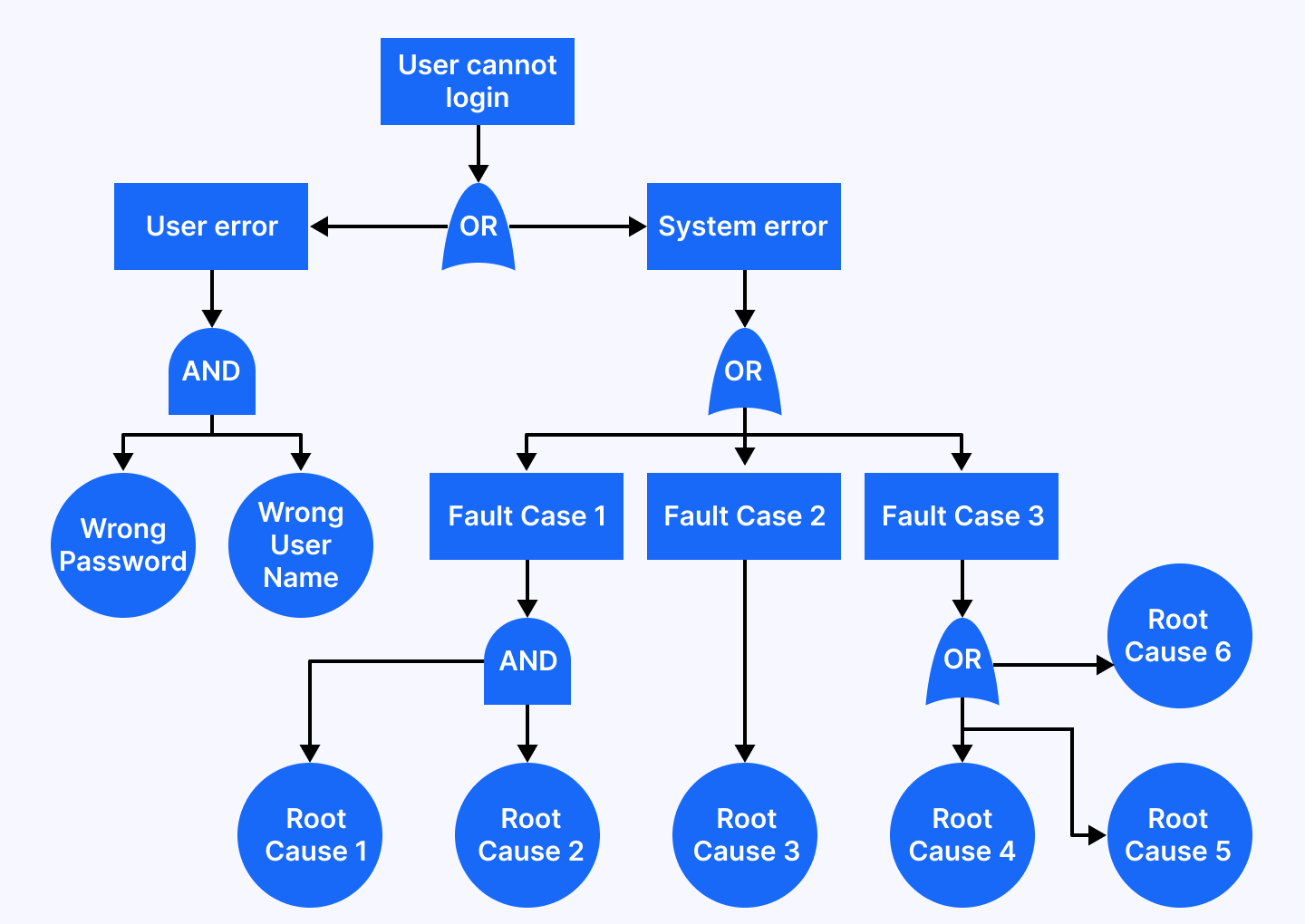
- Fault Three Analysis (FTA): The technique is used to identify the cause and effect of system failures. It involves creating a tree-like diagram representing the failure modes and their causes and then analyzing each potential cause to identify the most likely root cause.
It involves analyzing each component or step in the process to identify potential failure modes, their effects, and the likelihood of occurrence. FMEA helps identify high-risk areas and prioritize actions to prevent or mitigate potential failures.
The steps of FMEA involve the following:
It considers both observed failures raised from testing or production and potential failure rise from quality risks. Such failures are then subjected to root cause analysis which starts from defects causing failure, then with errors causing the defect, and continuing on identifying the root cause.
Which Risk Based Testing Technique to Choose?
The software testing technique in risk based approach depends upon the product, process, and project considerations. Quality risk analysis is integrated early in every sprint for Agile undertakings, and risks are cataloged alongside user story tracking. A precise estimate of test effort is crucial to successful project culmination.
For a complex system of systems, risk analysis is required for each individual system and the system of systems in its entirety. Projects that are mission-critical or safety-critical necessitate higher levels of formality and documentation in their risk based testing techniques. This method can be utilized at any phase, including user acceptance testing.
The essential component for effective risk based testing is the involvement of the appropriate team of stakeholders in risk identification and evaluation. These stakeholders usually fall into two groups: business and technical stakeholders. Every stakeholder brings their distinct perspective on what constitutes quality for the product and their priorities and concerns regarding quality.
Phases of Risk Based Testing
Risk based testing involves a series of steps that must be followed to test a software application successfully. Below are the steps explained in detail:
- Risk Identification
- Expert interviews
- Independent assessments
- Project retrospectives
- Risk workshops
- Checklists
- Brainstorming sessions
- Past testing experiences
- Delphi techniques
- Cause and effect diagrams
- Root cause analysis
- Risk Register
- Risk Assessment
- Risk Analysis
- Complexity of the software applications.
- Conflict in the team.
- Geographically distributed team.
- Software testing tools and technologies.
- Weak managerial.
- High earlier defect areas.
- Lack of early quality assurance activities.
- Frequency of use of impacted features of software applications.
- Loss of business.
- Loss of license.
- Safety.
- Damage to reputation.
The first step in risk based testing involves identifying the potential risk associated with software applications. You can identify the risk by various means. Some of those are
It is crucial to have clear communication amongst the development team who have encountered any potential risk in the past. This will help to understand the vulnerable area in the software application development, which could impact its functionality and performance. Along with this, the team also analyzes the requirements, design specifications, and documentation to identify potential risks.
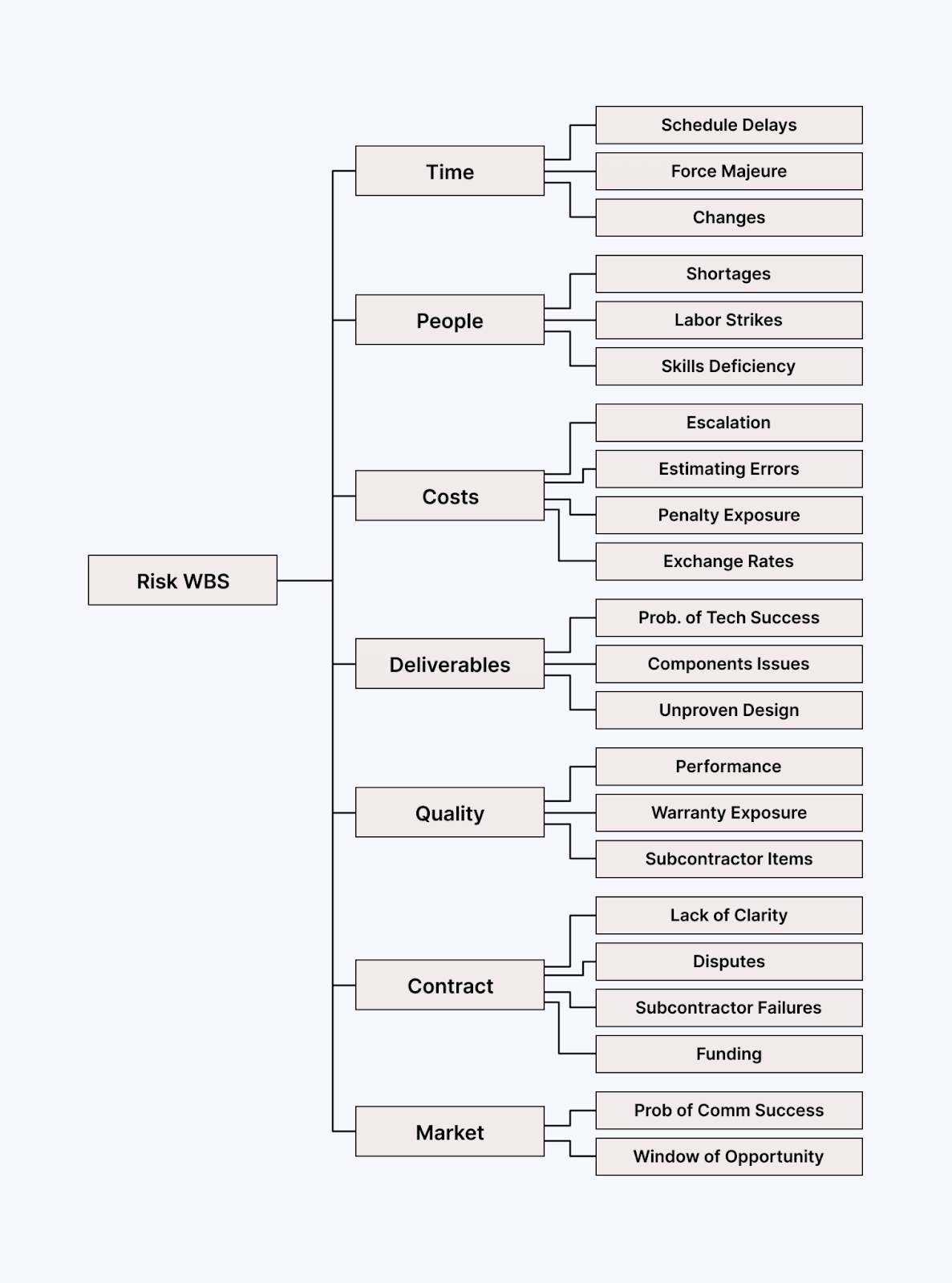
At this phase, a risk spreadsheet is maintained where identified risk is further divided into sub-risks called risk breakdown. Risk breakdown structure is a hierarchical representation of the list of identified risks organized by categories and sub-categories. This helps easy identification, analysis, and communication of software project risk to the stakeholders.
Registering the risk in a spreadsheet allows for tracking and monitoring risks throughout the software development process. You can identify the risk-prone area that eases resource and time allocation for risk management.
Here is an example of a risk breakdown structure, as shown in the below illustration. Typically it categorizes risk as external (associated with the market, legal and regulatory factor) and internal (associated with project management, technology, and resources). However, other than this, the risk associated with environmental and safety factors are also considered. Further, those risks are also subdivided into specific risks, which are then critically assessed.
When the risk is identified and sorted, risk assessment begins. However, risk assessment can also go parallel with risk registration to identify the likelihood and impact associated with each risk. In some cases, risk assessment also occurs during identification using a checklist.
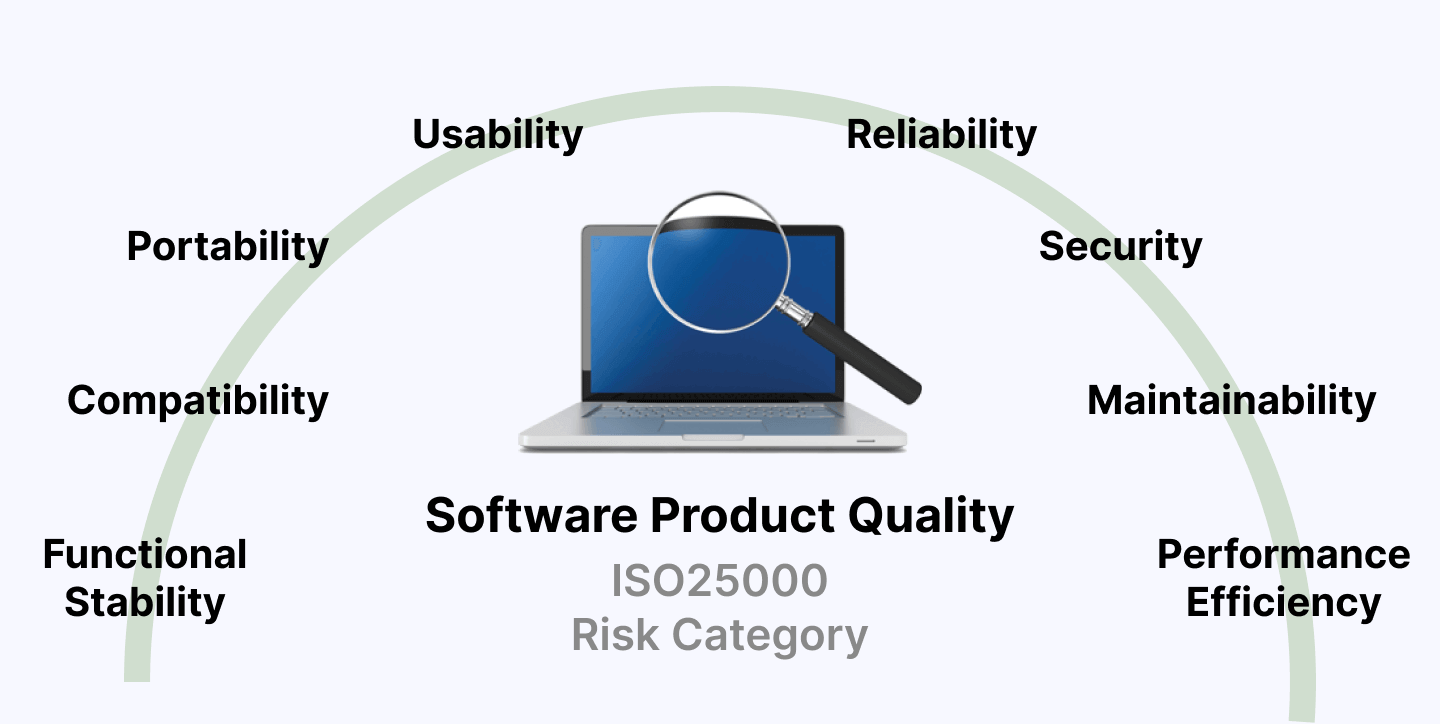
Here the risk is again categorized into appropriate types like performance, reliability, etc. Some organizations use ISO 25000 quality characteristics for categorizing. However, many others use different categorizing schemes.
After potential risk is listed and categorized based on assessment, they are analyzed and filtered using quantitative and qualitative risk analysis methods. However, it is important to know about the factor impacting the likelihood of risk and the factors influencing the impact of risk. Here are those:
Factors impacting the likelihood of risk:
Factors leading to the impact of risk:
The main objective of risk analysis is to differentiate between high-value and low values test cases to assign priority value. This involves the following steps:
Step 1: Using 3X3 Grid
In this method, the development team assesses each functionality and non-functionality of the software applications and associated test cases for likelihood or failure and the impact of failure.
The likelihood of failure of each functionality is analyzed by technical experts and categorized as likely, quite likely, and unlikely to fail.
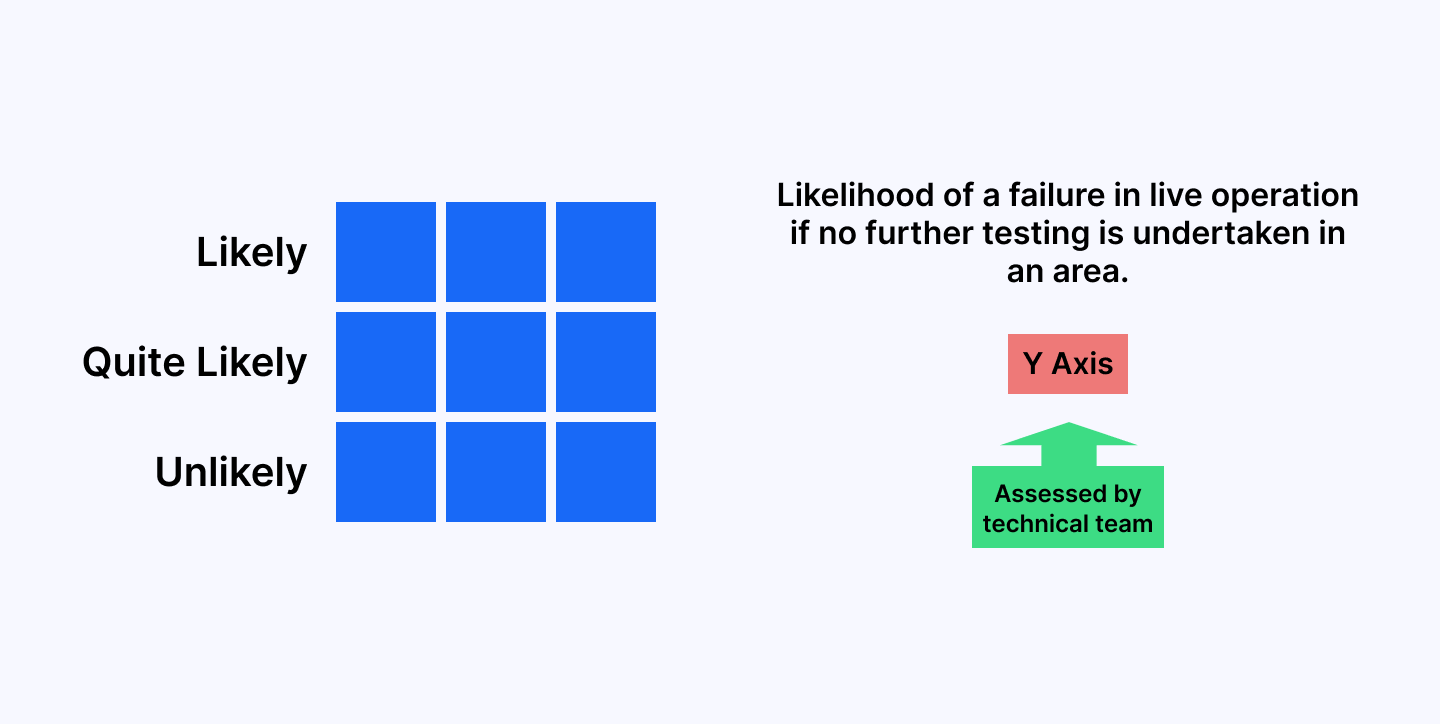
The impact of the failure of such functionality is categorized as minor, visible, and interruption.
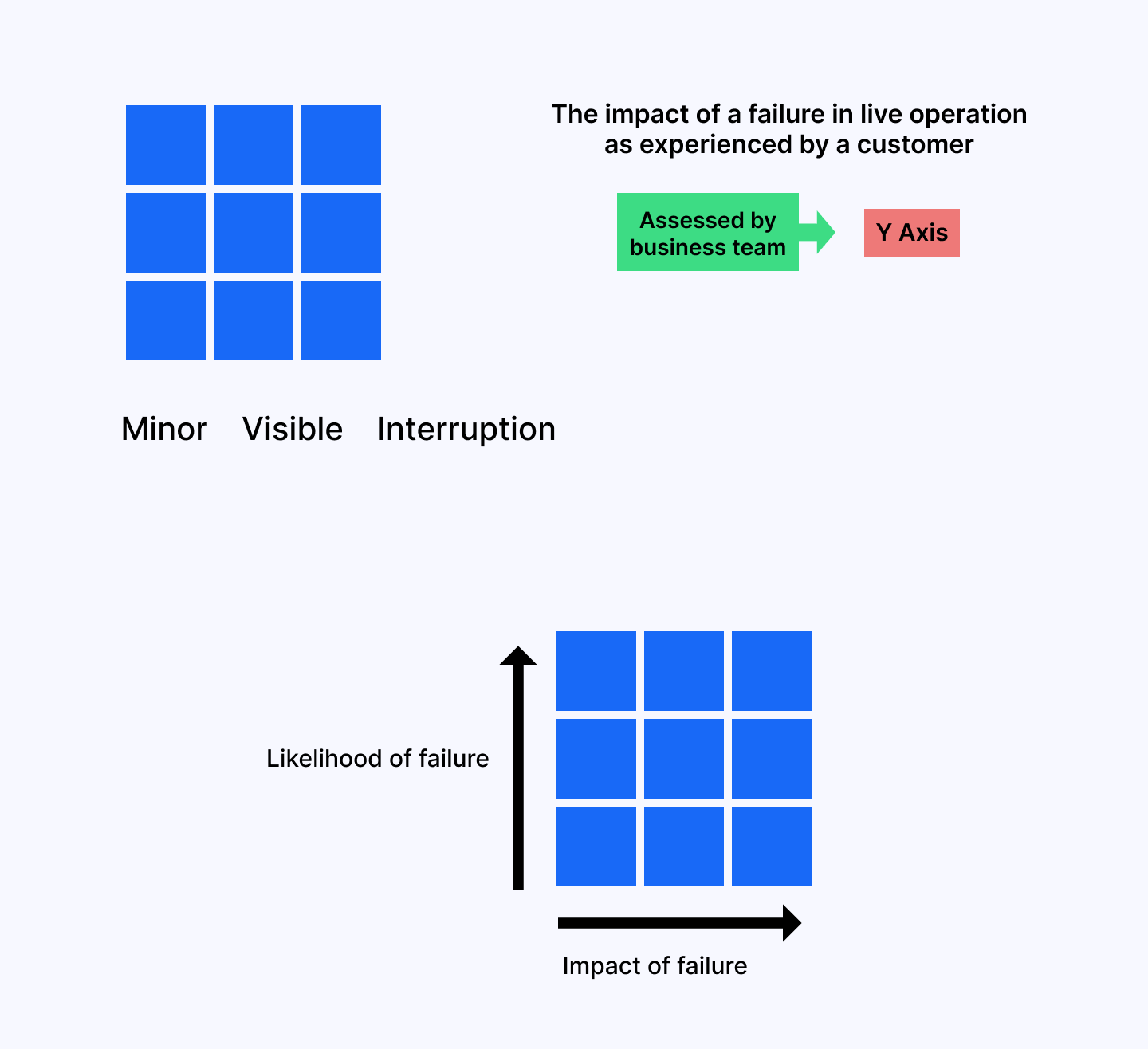
Step 2: Likelihood and Impact of Failure
The likelihood and impact of each identified risk are assessed and rated as either low, medium, or high likelihood, and minor, moderate, or severe impact. The resulting values position the corresponding test cases on a 3X3 grid.
To quantify the likelihood and impact, multiply the two values to calculate the risk priority number. However, in most cases, the risk level is also analyzed qualitatively, and the technique involved is Risk Matrix. This is used to find the probability and effect of risk.
Prioritization and Risk Assessment Matrix:
The risk rating measures the potential impact of risk and is calculated by multiplying the probability of the risk occurring by the severity of its consequences. This formula is commonly expressed as
Risk Rating = Probability x Severity
The prioritization and Risk Assessment Matrix is leveraged to evaluate the probability and severity of each recognized risk, also called the probability impact matrix; this matrix provides a quick overview of the risks and their corresponding priorities.
The likelihood and severity of the ambiguous circumstance are multiplied to gauge the risk rating. Probability is a percentage and can be classified as follows based on the possibility of the event happening:
- Frequent (91 - 100%)
- Probable (61 - 90%)
- Occasional (41 - 60%)
- Remote ( 11 - 40%)
- Improbable (0 -10%)
- Eliminated (0%)
Severity is evaluated on a scale of 1 to 4 and can be classified as Catastrophic, Critical, Marginal, or Negligible based on the event's impact.
Afterward, the resulting risk rating is applied to assign the risk to one of the four priority categories: Serious, High, Medium, or Low. These priority categories are charted against the severity and probability of the risk, as shown in the below matrix.
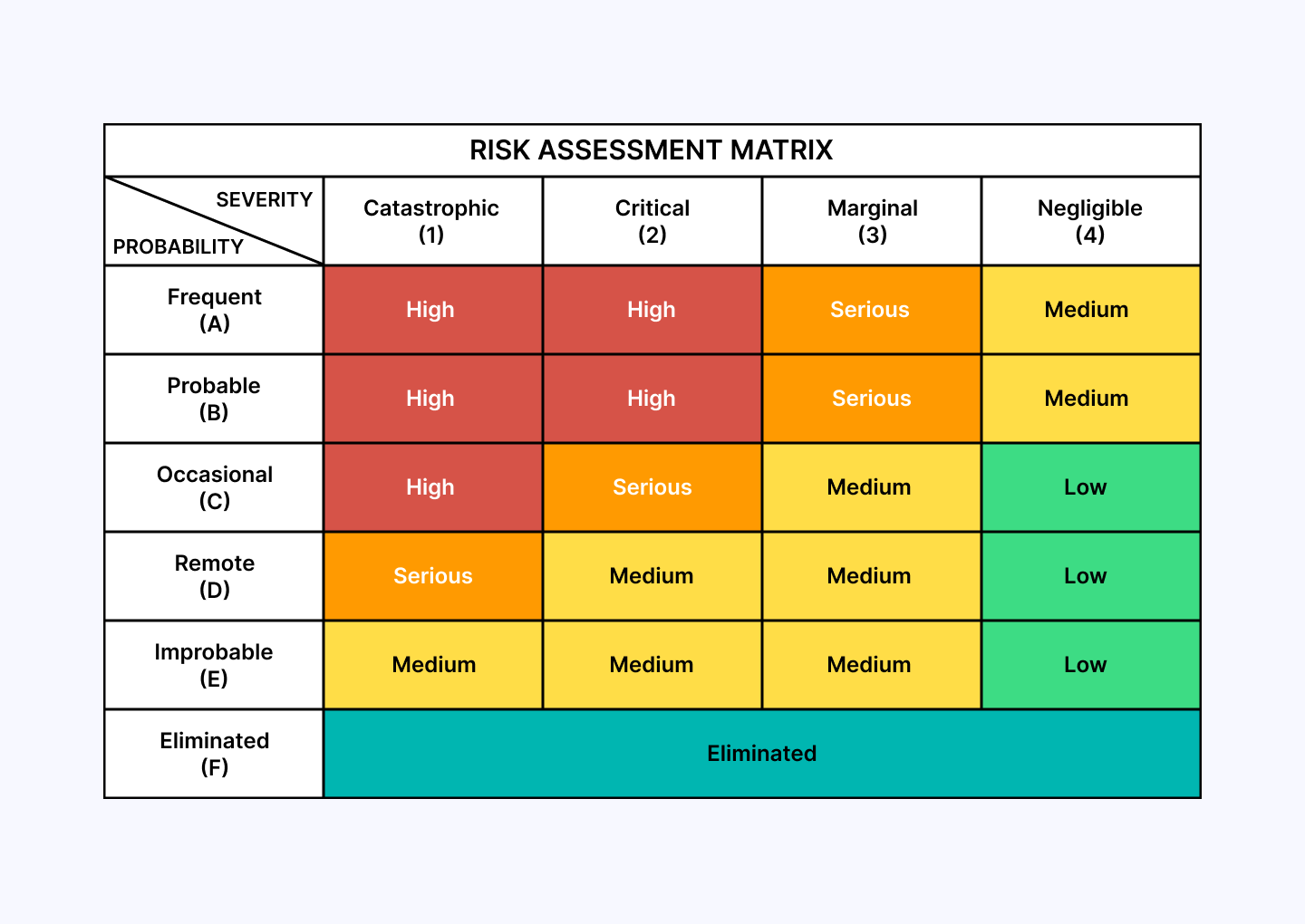
By utilizing the Prioritization and Risk Assessment Matrix, software development teams can promptly detect and prioritize risks, permitting them to concentrate their testing efforts on the most crucial areas of the software. This ensures that possible issues are resolved early in the development process, diminishing the probability of defects or failures and elevating the software's overall quality.
After assessing the risk level of each test case, the Risk Assessment Matrix, utilizing the probability and impact of failure, positions them on a 3x3 grid to determine their priority. This method enables the identification of high and low-value tests.
Step 3: Testing Priority Grid
This methodology involves the creation of a Testing Priority Grid based on the positioning of the test cases in the 3X3 grid outlined in Step #2.
The tests are prioritized and labeled with priority numbers 1, 2, 3, 4, and 5 based on the risk ratings assigned in Step #2. Tests with the highest risk ratings are assigned priority 1 and are situated in the top right corner of the grid, while the lower priority tests are given higher numbers.
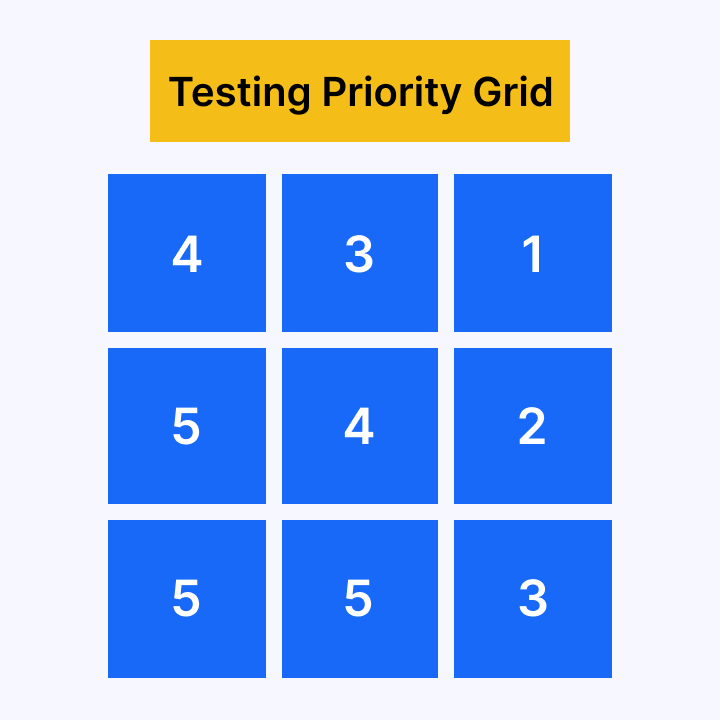
After priority numbers sort the test cases, they are executed according to the order of priority. Tests with the highest priority are executed first, as they pose the greatest risk to the project. In contrast, lower-priority tests may be executed later or even removed if necessary.
Using the Testing Priority Grid, the testing team can prioritize their testing efforts based on the potential impact of each identified risk, ensuring that the most important tests are conducted first, and potential risks are addressed early in the development process. This approach is designed to improve the overall quality of the software and reduce the likelihood of defects or failures.
Step 4: Details of Testing
In the fourth stage of the testing process, the emphasis is on determining the appropriate degree of detail for testing based on the prioritization of the test cases. Tests assigned a higher priority ranking, denoted by a value of 1, are deemed “More Thoroughly” and thus require a more comprehensive level of testing. To ensure that these high-priority features and their associated test cases are tested to a high standard, proficient testers must be assigned to the task.
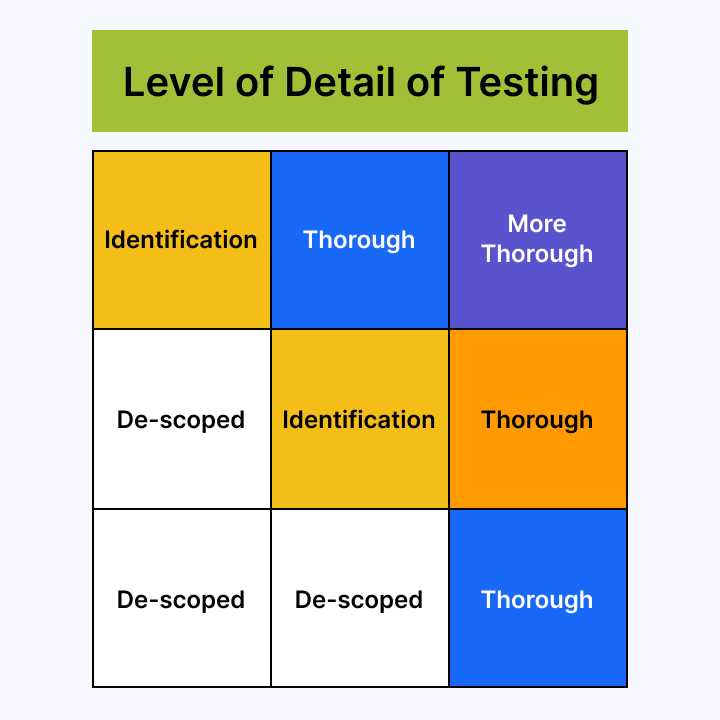
The same approach is taken for test cases with priority rankings of 2, 3, and 4; however, the level of detail involved in testing these cases may be reduced compared to those with a higher priority ranking. Finally, for test cases with a priority ranking of 5, a decision may be made to de-scope these features and tests based on the time and resources available. This implies that these test cases may need to be tested or receive minimal testing.
Risk Response Planning
It involves thoroughly analyzing the identified risks to determine if a response is necessary. The risk owner will assess whether it requires action during the project planning or monitoring phase or can be left unattended.
If the risk demands a response, the risk owner will evaluate various options to minimize the probability and impact of the risk on the project. These options include adjusting the project plan to eliminate the risk, allocating additional resources to mitigate the risk, or modifying the testing strategy to concentrate on the areas of the project most affected by the risk.
The primary objective of risk response planning is to minimize the impact of risks on the project and ensure that the project is completed successfully within the desired time and budget constraints.
Risk Mitigation
Risk mitigation involves taking measures to decrease the risk's possibility and/or impact. It can be done by eliminating or lowering the risk to an acceptable level. Risk mitigation aims to reduce the likelihood of any potential harm caused by these risks in the software applications and ensure that the establishment is adequately equipped to tackle any unforeseen circumstances.
There are many ways to mitigate risks. For example, an organization could implement safety protocols, establish redundant systems, train employees to handle emergency situations, or invest in insurance coverage. By taking these measures, the establishment can minimize the impact of potential risks and deter them from metamorphosing into significant predicaments.
Risk Contingency
Risk contingency concerns the probability of an unanticipated event with an indeterminate or unforeseeable impact. A contingency plan, or an action plan or backup plan, is a calculated measure to brace for worst-case scenarios. The purpose of a contingency plan is to ascertain what measures can be taken for an unpredictable event, such as a natural calamity, cyber assault, or supply chain disruption.
Risk Monitoring and Control
Risk monitoring and control processes are utilized to track the identified risk, monitor the residual risks, detect new risks, evaluate the change, execute the response plan, and monitor risk triggers. The primary purpose of this step is to effectively manage the risk throughout the software project and business process.
You can use several techniques and tools in risk monitoring and control, like risk assessments, risk audits, variance, and trend analysis, retroactive meetings, etc. when you implement these techniques; you will be able to manage the risks and ensure that the preparedness to respond to potential issues on time.
Approaches to Risk Based Testing
The risk based approach is a comprehensive strategy that involves scrutinizing the requirements of a project and assessing risks based on the probability and potential impact of each requirement. By identifying high-risk areas and prioritizing needs, the approach helps ensure that the highest-risk items are tested first. This is done by using a risk register to list identified risks and performing risk profiling to understand the risk capacity and tolerance levels.
The approach involves planning and designing tests according to the risk rating. The highest-risk items are given the most intensive coverage by employing appropriate testing approaches and design techniques. To ensure maximum coverage, the testing approach encompasses multiple functionalities and end-to-end business scenarios.
Furthermore, the approach employs peer review and dry runs to identify defects and mitigate risks. The results are reported and analyzed, and contingency plans are created for high-exposure risks. The approach also involves defect analysis and prevention, retesting, and regression testing to validate fixes based on pre-calculated risk analysis. High-risk areas receive the most intensive coverage.
Periodic risk monitoring and control, residual risk calculation, and reassessment of risk profiles are also critical components of the approach. Contingency plans are implemented as necessary. The approach can be used at every level of testing, and exit criteria or completion criteria are established based on risk levels. The ultimate goal is to ensure that all key risks are addressed with appropriate actions or contingency plans and that risk exposure is at or below the acceptable level for the project.
Risk can also be scored from the change itself rather than from a requirements review alone. In this TestMu Conf 2026 session, AI-Powered Impact-Based Testing for Faster, Safer Releases, Srikanta Sahoo and Navneet Goyal walk through a Smart Engine that identifies the tests most relevant to each code change, analyzing code modifications, dependencies, historical test results, semantic relationships, and test reliability to predict potential impact.

Risk Based Approach to System Testing
Risk based approach is used during system testing to prioritize and address testing efforts on the system's critical components based on potential associated risks. Such an approach is helpful to detect any risk in the system and determine the likelihood of its occurrence and impact on the system and users. It involves three different tests, which are explained below:
- Technical System Test: It involves an environment and integration test of the system. This involves testing the system in the development, testing, and production environment.
- Functional System Test: It involves testing of features, functionalities, modules, and programs of the system. Its main aim is to analyze if a system meets the end-user requirements.
- Non-Functional System Test: It involves testing non-functional requirements performance, load tests, stress tests, security, configuration, and documentation. This test help ensures that the system can perform in real-world scenarios.
The true capability of testing in real-world scenarios can only be leveraged when tested on real browsers, devices, and operating system combinations. Cloud-based digital experience testing platforms like TestMu AI offer real device cloud to perform manual and automated testing of your web and mobile apps on over 3000+ real browsers, devices, and operating systems.
TestMu AI can help in your risk-based approach to testing by providing a scalable online browser farm to test software applications (websites or mobile apps) across a wide range of combinations. Furthermore, you can create automated test suites or scripts that cover high-risk scenarios using automation testing frameworks like Selenium, Cypress, Playwright, and more.
Check our documentation to get started with automation testing.
Checklist of Risk Based Testing
Risk based testing is an exhaustive process that focuses on critical functionality and related potential risk associated. In this process, it is important to evaluate that the software application is thoroughly tested and that there is no miss of any potential risks. For this, a checklist help ensures that all critical components of software testing are tested. Here are some points to consider:
- Critical functionalities of the software project.
- End-user visible functionality of software project.
- Finds any functionalities with the largest safety impact.
- Functionalities with the largest financial impact on users
- High complex area of source code and error-prone code.
- Feature and function tested early in the development cycle.
- Feature and functions added to product design at the last minute.
- Critical factors of software projects are tested.
- Prime factors of software projects are tested.
- Poor requirement lead to poor design and testing and impacts software project goals.
- Problems that would cause persistent customer service complaints.
- End-to-end tests that could easily focus on the multiple functionalities of the system.
- Optimal set of tests that can maximize the risk coverage.
- Tests that will have the best high-risk-coverage to time-required ratio.
Risk Based Testing Tools
Risk-based testing is a prioritization discipline before it is a tooling problem, so the useful question is not which tool is most popular but which capabilities the approach actually depends on. Judge any candidate against these four, ideally alongside your automation testing tools:
- Risk attributes on the test case itself: Likelihood and impact need to live on the case as first-class fields, not in a side spreadsheet that drifts within a sprint.
- Requirement-to-defect traceability: You need to answer "which requirements are untested, and which failed" from one place. Without it, risk coverage is an assertion rather than evidence.
- Prioritized execution: The highest-risk cases must be runnable as their own cycle, so a shortened window still tests what matters most.
- Unified manual and automated results: Risk does not respect the split. If automated results live in one system and manual outcomes in another, the risk picture is always half-assembled.
TestMu AI's Test Manager covers those four in one workspace: a single traceability matrix connects requirements to test cases, execution history, and defects, so coverage gaps surface before a release rather than after, and manual outcomes land in the same cycle view as automated pipeline results. For a wider survey of the category, see our guide to test management tools.

Catch up on the latest testing tutorials around Selenium automation, Cypress testing, and more. Subscribe to the TestMu AI YouTube Channel for quick updates.

How to Perform Risk Based Testing?
Knowing different phases and approaches to risk based testing, it is equally important to be aware of the steps involved in executing it successfully. These are the steps you can follow to run Risk Based Testing.
- Step 1: The risk should be evaluated by preparing a list of the major components that constitute the application and identifying 10 to 15 significant functionalities. These critical functionalities should be labeled with a risk level, probability, and impact.
- Step 2: Evaluate the extent of the testing coverage against the risk assessment to identify any loopholes in your coverage. It is recommended that areas with high and medium risk should have sufficient testing coverage; otherwise, they should be prioritized.
- Step 3: Interact with the development and product management teams to apprehend the key features that will be incorporated and their possible impact and risk level.
- Step 4: Create a test plan that allocates more testing resources to high-risk areas. Critical features usually bring greater risks to the application, so it is important to prioritize them in the testing process.
- Step 5: As the procedure is executed, a better understanding of the efforts made, improved communication with the teams, and adjustments made to the test plan will be achieved. In due course, the objective is to attain a high level of test coverage while minimizing risk.
Risk Based Testing Metrics
The main goal of risk based testing is to identify and mitigate the high-risk area of the software application. In this process, it is important to evaluate the effectiveness of the testing process so that we can know how successfully identified risks in the software application development process are mitigated. Here are some known risk based testing metrics:
- Test coverage
- Defect density
- Test case effectiveness
- Defect severity
- Risk reduction
- Test effectiveness
- Defect leakage
- Quality cost
- Defect identification efficacy
- Test execution coverage
Risk Based Testing Report
The test report preparation is the process of creating documents that can be communicated to the project stakeholder on the risk based test result. Preparing a test report to clearly understand the testing process and compare the pre-defined test objective with the test result is essential. Risk based test reports need to be detailed, organized, and concise.
The following are the steps to prepare a test report:
- Identify the purpose and audience of the report: First, you have to understand the intended purpose and audience to determine which information should be included and how the report can be used.
- Define the scope of testing: You have to be clear about the scope of the testing performed. This involves the type of test, test environment, and system/application being tested.
- Describe the scope of testing: Here, you have to describe the testing process being used, which involves the testing method, test plan, and test cases. You must include any issues encountered in the risk based testing process.
- Present the result: You have to present the test results clearly and concisely. This involves using tables, charts, and graphs to visualize the data and highlight the severity and priority of the test.
It also involves information on the number of test cases planned vs. executed, number of test cases passed/failed, number of defects identified and their status & severity, number of defects and their status, number of critical defects- still open, environment downtimes - if any, showstoppers - if any, test coverage report.
- Provide recommendations: This involves giving recommendations for focusing on the defects found during the test. Such recommendations include code changes, test plan updates, and any additional tests required.
- Conclude the report: Conclude the report by summarizing the key findings and recommendations. This may also involve any lessons during the testing process and signify any area needing more attention in future testing efforts.
The 4 Pillars of a Risk-Based Approach
Strip risk-based testing back and four activities carry it. Teams that struggle with the approach have usually dropped one of them, and it is almost always the fourth.
- Risk identification: Enumerate what could fail, drawing on requirements, past defects, and the areas engineers are quietly nervous about. The output is a list, not yet a priority.
- Risk analysis: Score each item on likelihood and impact. This is where a list becomes a ranking, and where the two dimensions must stay separate. A rare catastrophe and a frequent annoyance are not the same problem.
- Risk response planning: Decide what to do about each item: mitigate it with tests, accept it and document the decision, or remove the feature. Not every risk earns a test.
- Continuous risk monitoring: Re-score as the product changes. A risk register written once at project kickoff is a historical document by the third sprint, and acting on it is worse than having none because it carries false confidence.
One technique worth knowing for the first two pillars is FMEA (Failure Mode and Effects Analysis), which walks each component, asks how it could fail, and scores the consequence. It is heavier than most teams need for a web app, but it is a useful discipline when the cost of a miss is measured in more than churn.
What is Requirements-Based Testing?
Requirements-Based Testing (RBT) derives every test case directly from the Software Requirements Specification (SRS). Where risk-based testing asks "what would hurt most if it broke", requirements-based testing asks a stricter question: "is every stated requirement proven?"
The instrument that makes it work is the Requirements Traceability Matrix (RTM), a table mapping each requirement to the test cases that exercise it. Read down the matrix and an untested requirement is visibly a hole rather than an oversight nobody noticed. That is the point: RBT targets 100% requirement coverage, which is a different goal from 100% code coverage and a much different goal from risk-based prioritization.
This matters most where coverage is not a preference but a condition of shipping. Safety-critical industries mandate it: DO-178C governs airborne software certification, and ISO 26262, titled "Road vehicles - Functional safety", governs automotive electronics. In those contexts a requirement without a traced test is not a backlog item, it is a blocked certification.
The honest trade-off: RBT proves the specification and nothing else. If a requirement is missing or wrong, a perfectly green RTM says everything passed. That blind spot is exactly what risk-based and exploratory approaches exist to cover, which is why mature teams run more than one.
What is Session-Based Testing?
Session-Based Testing (SBT) is exploratory testing with an accountability structure bolted on. It answers the standard objection to exploratory work, which is that it produces insight but no evidence, by making the session itself the unit of measurement.
Session-Based Test Management (SBTM) has six elements, and skipping any one of them collapses it back into unstructured clicking:
- Mission: Why this testing exists at all. The standing purpose behind the effort.
- Charter: A short written goal for one session. "Explore checkout with expired cards to discover error-handling failures" is a charter. "Test checkout" is not.
- Session: An uninterrupted, time-boxed block, conventionally around 90 minutes. The time-box is what makes sessions countable and comparable.
- Session report: What was tested, what was found, what got in the way, and how time split between testing, investigating bugs, and setup.
- Debrief: A short conversation between tester and lead about the report. This is the quality control step, and it is the one teams quietly drop first.
- Parsing results: Aggregating reports across sessions so coverage and effort become reportable numbers rather than anecdotes.
SBT pairs naturally with a risk-based approach: use risk analysis to decide which areas deserve charters, then spend sessions there. The risk register picks the target, and the session structure proves you actually went.
Risk-Based vs Requirements-Based vs Session-Based Testing
| Parameter | Risk-Based | Requirements-Based | Session-Based |
|---|---|---|---|
| Driving question | What hurts most if it breaks? | Is every requirement proven? | What do we not know yet? |
| Test source | Risk register, likelihood and impact scores | The SRS, traced through an RTM | A charter, plus the tester's judgment in the moment |
| Documentation | Risk register and prioritized cases | Heaviest: full traceability matrix | Lightest: session reports and debriefs |
| Coverage goal | Deliberately partial, ranked by risk | Complete against the spec | Unbounded by design |
| Best fit | Short windows, limited resources, uneven risk | Regulated and safety-critical work | New or poorly specified features |
| Main blind spot | Mis-scored risk goes untested | A wrong or missing requirement still passes | Depends heavily on tester skill |
Mistakes to Avoid in Risk Based Testing
There are different ways to analyze and evaluate risk in software applications which undergo various forms based on context. Despite this, there are common mistakes that should be avoided in risk based testing. Some of those are as follows:
- Performing risk based testing at the end of the Software Development Life Cycle.
- Defining the acceptable level of risk in the wrong way.
- Ignoring the high-risk areas or components of software applications.
- Not focusing on the risks which might affect the future performance of the software application.
- Involving in risk based testing without having the experience or knowledge to understand the impact of the test altogether.
It is recommended to start the risk analysis during the planning and development phase of the Software Development Life Cycle to evaluate and develop an effective test approach correctly.
Note: Expedite release velocity with blazing-fast test automation. Try TestMu AI Now!
Challenges of Risk Based Testing
Risk based testing is an approach to maximize the efficiency of the testing and comes with its own set of challenges. Such challenges need to be understood so that they can be addressed while performing risk based testing. This will help you ensure no miss of the critical risk area of the software application. Here are some of the common challenges:
- Lack of proper planning: It is one of the major challenges that may lead to a miss of effective risk analysis in software applications. There is a need to have a thorough understanding of the software application and its associated risks.
- Difficulty in identifying risk: This challenge is encountered mainly when risk based testing is performed in complex software applications involving multiple components to be tested. Therefore, it might be challenging to determine which components should be prioritized for a high-risk level.
- Lack of resources: In risk based testing, a high amount of resources like time and budget is needed. However, its allocation to testing is challenging due to competing priorities.
- Incomplete coverage: As risk based approach only involves testing critical components of software applications, other important components are left to be thoroughly tested, leading to incomplete test coverage.
- Lack of consistency: Risk based testing requires consistent implementation across the organization. This can be challenging, especially when different teams are responsible for other areas of the software.
Best Practices of Risk Based Testing
Risk based testing is an important aspect of software development, and there exist several best practices to ensure its success:
- You should early identify any critical risks during the planning phase of software development, where addressing them is easier and budget friendly.
- Collaboration is also essential in risk-based. This requires effective cooperation from various stakeholders, such as developers, testers, and business analysts. It will help in identifying potential risks and prioritizing testing efforts.
- You should perform a comprehensive risk assessment which involves identifying risks and evaluating their impact on the software application.
- Based on the risk assessment, testing efforts should be prioritized to focus on the most critical component of the software application.
- You can use test automation to support risk based testing by automating the testing of high-risk areas of the software application.
- You should perform continuous risk assessments throughout the development life cycle.
Conclusion
Risk based testing is an approach to software testing that prioritizes the critical functionality of the software or system. This strategy aims to optimize the testing process's efficiency and effectiveness, eventually improving user experience and high-quality software.
In this approach, the level of risk is identified, assessed, analyzed, and mitigated based on its prioritization. This strategy reduces over-testing, thereby optimizing the efficiency of the testing process.
The risk based approach requires effective collaboration and communication between the stakeholders like developers and testers involved in the software project. When you involve all views in the risk assessment, the team can easily ensure potential risk identification and its fixes.
Author

Nazneen Ahmad
Blogs: 44


Nazneen Ahmad is a freelance Technical Content SEO Writer with over 6 years of experience in crafting high ranking content on software testing, web development, and medical case studies. She has written 60+ technical blogs, including 50+ top-ranking articles focused on software testing and web development. Certified in Automation Basic and Advanced Training - XO 10, she blends subject knowledge with SEO strategies to create user focused, authoritative content. Over time, she has shifted from quick, keyword-heavy drafts to producing content that prioritizes user intent, readability, and topical authority to deliver lasting value.
Reviewer

Deepak Sharma
Reviewer
Deepak Sharma is a B2B SaaS content strategist with 5+ years of experience creating valuable content in the tech space. He has authored 100+ technical articles. At TestMu, he is a content lead, where he develops high-value content for readers. He believes writing isn't about sounding impressive it's about clarity and structure. He holds certifications in Cypress, Appium, Playwright, Selenium, Automation Testing and Kane AI.


Risk Based Testing FAQs
Did you find this page helpful?
More Related Blogs
TestMu AI forEnterprise
Get access to solutions built on Enterprise
grade security, privacy, & compliance
- Advanced access controls
- Advanced data retention rules
- Advanced Local Testing
- Premium Support options
- Early access to beta features
- Private Slack Channel
- Unlimited Manual Accessibility DevTools Tests